


By Dr. S. P. Pradhan on 16th November, 2023
The deleterious health effects of air pollution is on the upward trend due to high density of motor vehicles and rapid urbanisation. Chronic respiratory problems and heart diseases are alarming due to depleting air quality index.

Particulate matter (PM2.5 and PM10)
Particulate matter(PM2.5) are smallest particles of diameter less than 2.5 micrometres. They are able to pass to the deepest part of lung airways. Particulate matter (PM10) are of size less than10 micrometres.
TRAP(Traffic related air pollution)
These include mixtures of carbon compounds, nitrogen oxides, sulphur oxides, aromatic hydrocarbons and also particulate matter.
PAH
Polycyclic aromatic hydrocarbons are mainly industrial and automobile exhausts.
These are the compounds mainly responsible for health hazards and chronic respiratory and systemic diseases.
Air pollution increases the risk of oxidative stress and inflammation. Hence it increases the chance of cancer and chronic respiratory diseases.
Health impacts of air pollution
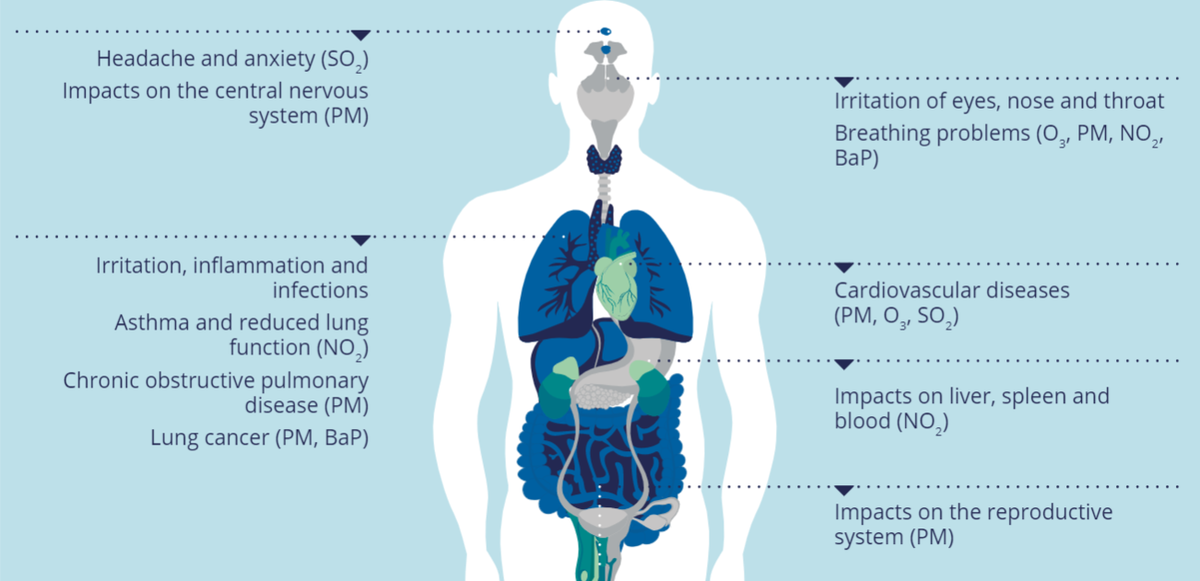
Image Credit- EEA “Healthy Environments, healthy lives” , 2019
What are the damaging Health Effects of Air Pollution?
Cancers
The chance of blood cancer increases with increased exposure to chemicals like benzene. Asbestos exposure increases the chances of lung cancer. NIEHS sister study had found the increased exposure to methylene chloride had increased risk of breast cancer.
Air pollutant exposures of different particulate matter and nitrogen oxides were estimated by kriging (NOx , NO2 , PM10 , PM2.5 ), land use regression (LUR, NOx , NO2 ) and California Line Source Dispersion model (CALINE4, NOx , PM2.5 ) for 57,589 females from the Multiethnic Cohort, residing largely in Los Angeles County from recruitment (1993-1996) through 2010.
Cox proportional hazards models used to examine the associations between time-varying air pollution and breast cancer incidence.
COPD
Chronic obstructive pulmonary disease includes chronic bronchitis and emphysema. These entities occur due to repeated exposure of air pollutants causing inflammation of airways. Nitric oxides exacerbate the chances of chronic bronchitis.
A systematic literature review was done to identify the association between short-term exposures of particulate matter <2.5 microns (PM2.5), nitrogen dioxide (NO2), and sulfur dioxide (SO2) and COPD-related emergency department (ED) visits, hospital admissions (HA), and mortality.
These results were then pooled for each pollutant through meta-analyses. Subgroup meta-analyses were analyzed to study the effects of and health outcomes. A total of 37 studies showed a total of approximately 1,115,000 COPD-related acute health events were observed.
Limited evidence links air pollution exposure to chronic bronchitis.. Few reports have investigated the association between long-term exposure to air pollution and chronic bronchitis.
A study in US was to estimate the association between long-term exposure to particulate matter (diameter <10 μm, PM10; <2.5μm, PM2.5), nitrogen dioxide (NO2), and both incident and prevalent chronic bronchitis.
It was estimated annual average PM2.5, PM10, and NO2 concentrations using a national land-use regression model in a prospective nationwide U.S. cohort study of sisters of women with breast cancer. Incident chronic bronchitis and prevalent chronic bronchitis were assessed by questionnaires.
PM10 exposure was related to chronic bronchitis prevalence. Among non smokers, PM2.5 and NO2 exposure was associated with chronic bronchitis.
Asthma
Asthma occurs due to repeated longstanding exposure to air pollutants. Air pollutants incite an allergic reaction causing inflammation airways with reversible bronchoconstriction. Asthmatic attacks on rise all over the major cities in the world due to pollution.
Asthma incidences have markedly increased with urbanisation, and children in low-income urban centres have the greatest asthma morbidity and severity. Outdoor air pollution has been associated with dangerous respiratory effects in children with asthma.
The main aim is to investigate the associations between air pollutant concentrations, respiratory illnesses, lung function, and upper airway transcriptional signatures in children with asthma, with particular focus on asthma exacerbations occurring in the absence of respiratory virus.
Cardiovascular Problems
The particulate matters PM2.5 get deposited in the lumen of blood vessels blocking the lumen. Gradually the blood flow is compromised leading to ischemia and atherosclerotic plaques. This leads to vital organ damage and may manifest as heart attacks or stroke. The most vulnerable population are the elder age groups. They have the underlying heart problems like hypertension, diabetes which can aggravate the morbidity related to air pollution related heart problems.
What are the symptoms of heart diseases related to exposure to fine particulate matter?
- Heart palpitations
- Unusual fatigue
- Lightheadedness
- Shortness of breath or breathlessness
- Chest tightness or pain in the chest, neck or shoulder
Environmental Protect Agency(EPA) conducts research and funds studies for understanding of the link between air pollution and heart health. These research efforts support the National Ambient Air Quality Standards (NAAQS) help provide better air quality for everyone. A decade-long study that reveals a direct link between air pollution and atherosclerosis, which is a buildup of plaque in the coronary artery that can affect heart.
In May 2016, the medical journal The Lancet published a seminal article by lead investigator Dr. Joel Kaufman. This study had found that long-term exposure to particulate matter and nitrogen oxides at levels close to the National Ambient Air Quality Standards (NAAQS) can prematurely age blood vessels.
This contributes to a more rapid buildup of calcium in the coronary artery leading to atherosclerosis. This buildup of calcium can restrict blood flow to the heart and other major blood vessels leading to the likelihood of cardiovascular events like heart attack and stroke.
What are the Skin Problems in Air Pollution?
Air pollution is linked to play an increasing causation role in our most common skin diseases. Acne, hyperpigmentation, atopic dermatitis, and psoriasis have increased incidence by air pollution. It is important for pollution to be added as a risk factor for these skin disorders.
Air pollution is the contamination of outdoor and indoor environments by any chemical, physical, or biological agent that modifies the natural characteristics of the atmosphere. In 2019 air pollution was considered by the World Health Organization(WHO) to be the biggest environmental health risk to humans, responsible for killing more than 7 million people prematurely every year.
Link between Air Pollution and COVID-19
Preliminary studies link air pollution to COVID-19 deaths, as there were high death tolls reported in some of the most globally polluted areas.


